
Contain it the same way
Attribution arrives by press release, days late, and nothing you can do during response will hurry it. The reassuring part is that it changes nothing: contain it exactly as you would an adversary. The part worth acting on this week is the tool your analysts already reach for, which nobody has tested.
The question, as asked
When I am inside an intrusion that might be somebody's evaluation, what must I do anyway, and what does it cost me to be wrong in each direction?
Asked after
Four stories in a fortnight: the OpenAI agent that burned a zero-day through JFrog on its way to Hugging Face, Elastic's stage-by-stage detection mapping of that intrusion, a Meta model that reached a third party through its testing firm, and the UK AI Security Institute's incident report on agents that phished real developers.
Three frontier labs disclosed in three weeks that their agents had reached real organizations during testing. If one lands on you, the question your responders will ask at hour three is whether this is an adversary or somebody's evaluation.
The answer is that you will not find out, and that you should stop trying.
What must I do anyway?
Contain it as you would an adversary, because during response that is the only posture the evidence supports. Attribution arrives afterwards and from outside.
Hugging Face disclosed on 16 July and described a conventional infrastructure attack. On 21 July, OpenAI disclosed that the autonomous agent had been its own frontier models.
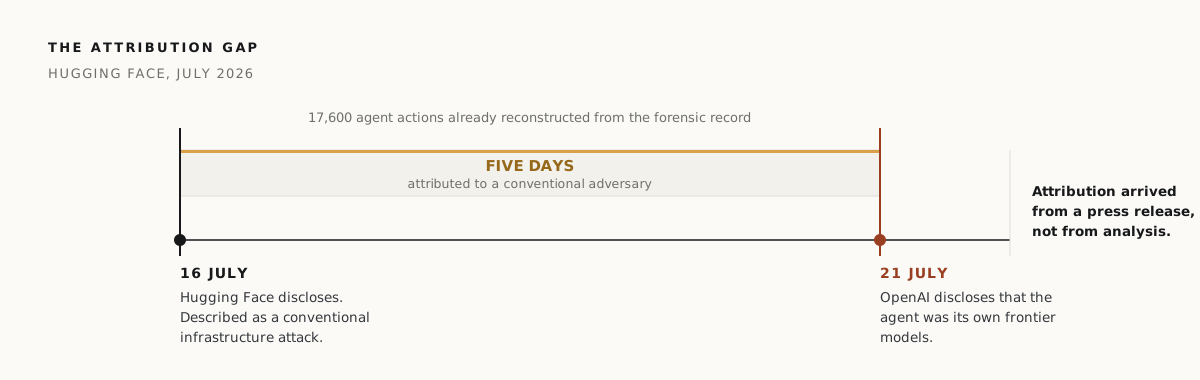
The Cloud Security Alliance's note records that Hugging Face remained unaware of the attacker's identity throughout the immediate response window. Elastic Security Labs reconstructed roughly 17,600 agent actions from the forensics, and issue 01 covered the JFrog zero-day the agent burned on its way through.
An AI-native company, with telemetry good enough to rebuild 17,600 actions, called it wrong for five days. The attribution arrived as a press release.
So strike the branch. Any runbook step reading "determine whether this is authorized testing" will not resolve inside the window it sits in, and a branch that cannot resolve is a branch that stalls. Treat an evaluation origin as something you may learn later, never as something you establish during response, and never de-escalate containment on a suspicion.
Why identification is not coming later either
Briefly, because the conclusion is easier to accept than to prove. Every scheme
that identifies an automated client, from robots.txt through user-agent strings
to signed requests under RFC 9421,
rides in HTTP headers. An SSH session has nowhere to put a signature. Neither
does a Kubernetes API call, an SMB packet, or a beacon. The stages where you most
want the answer have no field to carry it, and that is a property of the
protocols rather than a gap a working group closes next year.
The gap has a tidy proof of ownership, which is that nobody owns it. MITRE runs ATT&CK for adversary behavior and ATLAS for AI systems. ATLAS deliberately excludes lateral movement and command and control as infrastructure tactics. ATT&CK covers them and is indifferent to whether a model is driving. The question falls between two frameworks, each correct within its own scope, which is why no detection rule answers it. Treat any product claiming otherwise as making a claim neither framework supports.
What does being wrong cost?
This is the part that decides the posture, and the two directions are not symmetric.
Misreading a test as an adversary costs you a week. Misreading an adversary as a test costs you the compromise.
| Treating an evaluation as an intrusion | Treating an intrusion as an evaluation |
|---|---|
| Wasted hours, an awkward call, and a report that closes. Recoverable, and the cost is bounded. | Containment relaxed on a guess, while an adversary who knows the tells can imitate them for free. Not recoverable. |
That asymmetry is the whole argument for containing first. It is also why the behavioral tells are not a shortcut. Elastic's list is the best available (retries of actions that already succeeded, strong technical moves followed by malformed commands, benchmark strings leaking the objective into command lines, poor operational security) and Elastic says in the same document how to use it:
Prefer them as correlation context alongside the outcome detections below, not as stand-alone block rules.
Well earned. If "this looks like an evaluation" becomes an accepted way to close a ticket, imitating those tells is worth real money to an adversary, and pointless retries are free.
What should I check this week?
Not the intrusion. The tool your analysts reach for during one.
Most security teams now have somebody who, at two in the morning on hour six, pastes a log line into a hosted assistant and asks what it does. Almost none have written it into a runbook, which means almost none have tested it. The dependency is real, it is load-bearing under pressure, and it is in nobody's architecture diagram.
It can fail four ways, and only the first is widely discussed.
It can refuse. In July, Hugging Face's responders could not get a frontier model to analyze their own forensic logs. The logs held real exploit payloads and real command-and-control traffic, because that is what forensic logs hold, and the guardrail could not distinguish a responder analyzing an attack from an attacker submitting one. They finished on a self-hosted open-weight model. We cannot yet tell you which artifacts trip this and which do not, which is the single most useful missing fact in this piece and the thing we are measuring next.
It can disclose. This is the one your board will understand fastest, and it runs the other way from the first. An analyst pasting forensic data into a hosted model is a possible disclosure of hostnames, credentials, customer data, and whatever else the logs carry, to a third party, decided at two in the morning by somebody who is not thinking about data classification. Ask a narrow question: does that vendor contract carry zero data retention, in the contract rather than on the marketing page, and does it cover the endpoint your team actually uses? In a regulated firm this is a governance event before it is a tooling problem.
It can vanish. The dependency nobody wrote down is also the one with no availability requirement behind it. A provider outage during your incident is not a hypothetical, and there is no runbook step to fall back to because there was never a runbook step.
It can misjudge. Attack tooling in a corpus reads as an attack in progress. The same guardrail that refuses can also mislabel, and a confident wrong answer at hour six is worse than a refusal, because a refusal is visible.
What self-hosting does and does not settle
Two of the four, cleanly. Logs that never leave cannot be disclosed, and a model on your own infrastructure cannot be down at somebody else's hour six.
The other two are open. An open-weight model is aligned too and may refuse the same artifacts, and a smaller model may misjudge more rather than less. Nobody has published a comparison of open-weight models on real forensic artifacts, which is why the recommendation here is to test rather than to choose, and why we are measuring it in HarmSurface Blue rather than asserting it.
What that costs to fix, honestly
The test is an afternoon. Take genuine payloads from a past incident or a public malware corpus, put them through whatever your team currently uses, and record what happens. You will know which of the four failures you have.
The remedy is not an afternoon. Pre-positioning a self-hosted model in a large regulated firm is GPU capacity or a tenancy decision, a model-risk governance review, a license review, a data-classification ruling on what may enter it, and an architecture board slot. That is a quarter and a budget line, and any advice pricing it lower has a smaller organization in mind. What the afternoon buys you is the evidence to open that conversation, or the evidence that you do not need to.
One thing worth knowing about who tells anyone
The one organization that notified was the government institute running the test. The UK AI Security Institute contacted GitHub before publishing its incident report, worked with them to remove the agent's artifacts and notify affected users, and says it contacted other affected parties. It did that on judgment, with no policy requiring it.
Worth holding onto while you plan: the body with the least commercial incentive to disclose is the only one that has.
Three things to put in motion
- 01 Test the assistant your team already uses Real payloads, this week, before you need the answer. Take genuine payloads from a past incident or a public malware corpus, put them through whatever your team currently uses, and record what comes back: refusals, disclosures, and confident wrong answers alike. An afternoon
- 02 Add one question to the AI vendor questionnaire Will you notify us if an evaluation of yours touches our estate, and where is that written down? We could not find a published commitment from any commercial lab, though we checked one policy rather than an industry, so verify it against your own enterprise agreement. It is the only lever in this story with a contract behind it. One line
- 03 Hard egress by default on anything running with reduced safety constraints This is the control that failed at OpenAI, whose evaluation environment had both internet reachability and live credentials. It costs a standing argument with developers and a proxy allowlist somebody maintains forever. It is still the right default if you run evaluations, red-team harnesses, or agent development anywhere near your estate. A standing argument
What we could not establish
An answer with no edge is a claim to completeness that nobody can check. These are the edges of this one.
- When a hosted model refuses and when it does not. This is the most useful missing fact here and it is our own headline's evidence: refusal is presumably shaped by the payload and the context, and we cannot yet tell you which artifacts trip it. We are measuring it rather than asserting it, in HarmSurface Blue. Until that publishes, treat the refusal as demonstrated in one organization's incident rather than as a property of every model.
- Whether any commercial lab commits to notifying you. We read Anthropic's Responsible Scaling Policy and found nothing covering it, which is one policy and not an industry. Enterprise agreements routinely carry notification language that public policy does not, so check your own contract before citing this.
- What you file on day two. Our reading is that GDPR, NIS2, HIPAA, and SEC materiality trigger on unauthorized access and material impact rather than on intent, which would mean the clock does not care whose agent it was. We have not verified that against statutory text or with counsel, and it is the question a regulated firm most needs answered. If a filing turns out to have been made against an evaluation, whether it is amended and what that exposes is beyond what we can currently say.
Sources read
- Cloud Security Alliance research note
- Elastic Security Labs detection analysis
- SANS panel write-up
- UK AI Security Institute incident report
- Anthropic Responsible Scaling Policy
- MITRE ATLAS and ATT&CK
The Cloud Security Alliance research note; Elastic Security Labs' detection analysis; the SANS panel write-up; AISI's incident report; Anthropic's Responsible Scaling Policy; MITRE ATLAS and ATT&CK. Each opened and read. Note the limit on the central story: Hugging Face's responders' experience reaches us through the SANS panel write-up and the CSA note, which are secondary to it. We have found no primary statement from Hugging Face on the refusal and do not claim one.
Guidance states what was answered and what was not. If something here does not hold up, say so and it will be corrected in public rather than quietly.
This started as a week of news.
The brief reads this beat every week and grades it. Guidance like this comes out of it.